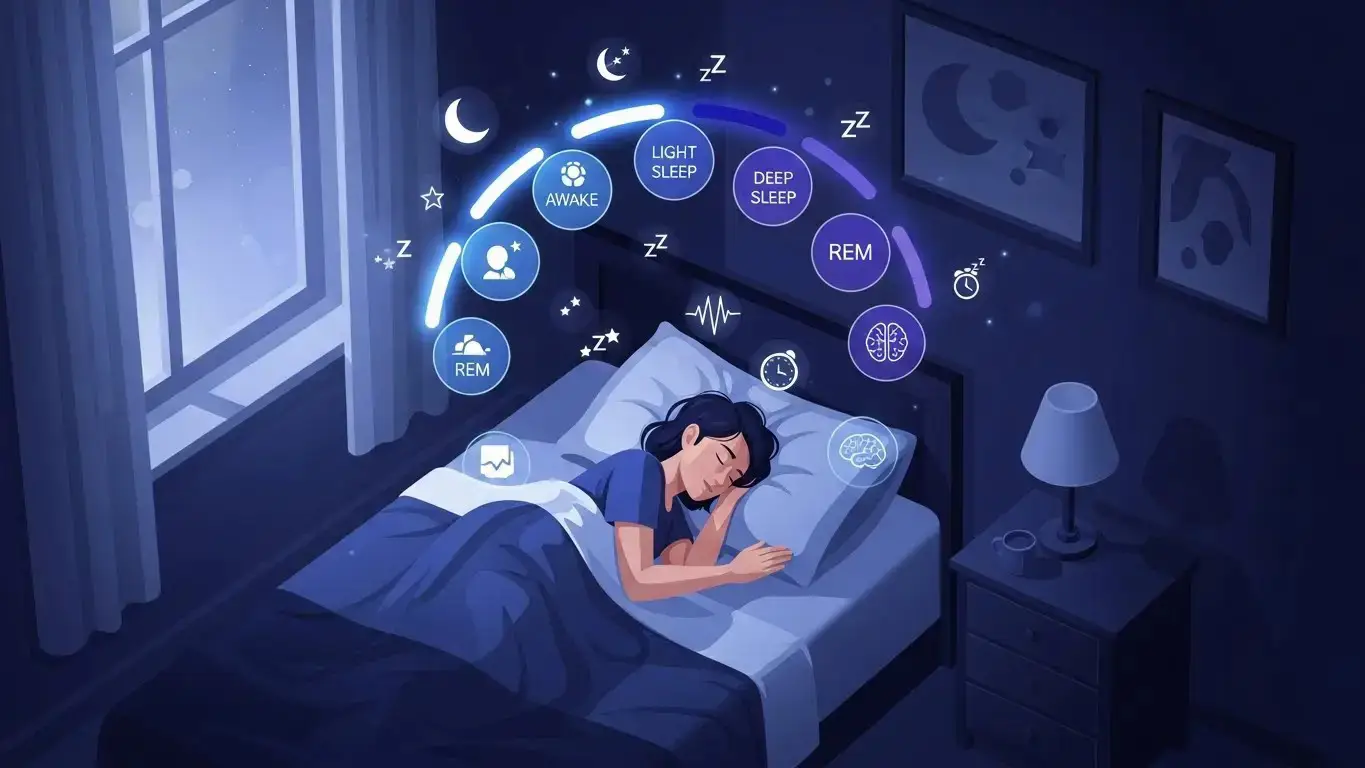
What Are Sleep Cycles?
Sleep isn't a continuous state of unconsciousness. Instead, it's a dynamic process that unfolds in predictable patterns called sleep cycles. Each cycle lasts approximately 90 minutes and consists of distinct stages that serve different restorative functions.
Why Cycles Matter
Waking up in the middle of a deep sleep stage causes "sleep inertia" — that groggy, disoriented feeling. By aligning your wake-up time with the end of a sleep cycle (when you're in lighter sleep), you can wake up feeling refreshed and alert.
The concept of sleep cycles was first discovered in the 1950s through EEG (electroencephalogram) studies. Researchers found that sleep progresses through distinct stages in a cyclical pattern throughout the night.
The 4 Stages of Sleep
N1 - Light Sleep
The transition phase between wakefulness and sleep. Muscle activity slows, and you can be easily awakened.
N2 - Deeper Sleep
Body temperature drops, heart rate slows, and sleep spindles (brain activity bursts) occur. This stage constitutes about 50% of total sleep time.
N3 - Deep Sleep
Also known as slow-wave sleep. This is the most restorative stage where tissue repair, growth hormone release, and immune strengthening occur.
REM Sleep
Rapid Eye Movement sleep where dreaming occurs. Brain activity increases, eyes move rapidly, and muscles are temporarily paralyzed. Crucial for memory consolidation and learning.
Sleep Stage Comparison
| Stage | % of Sleep | Main Functions | What Happens If Deprived |
|---|---|---|---|
| N1 (Light) | 5% | Transition to sleep | Difficulty falling asleep |
| N2 (Deeper) | 50% | Memory processing, body maintenance | Reduced cognitive function |
| N3 (Deep) | 20-25% | Physical restoration, hormone release | Fatigue, weakened immune system |
| REM | 20-25% | Memory consolidation, learning, dreaming | Poor memory, mood disturbances |
The 90-Minute Cycle Explained
A complete sleep cycle includes all stages from N1 through REM sleep and typically lasts 90-110 minutes. Here's what happens throughout a typical night:
Key Insight: REM Sleep Increases
Notice how REM sleep duration increases with each successive cycle. The first REM period might last only 10 minutes, while the final REM period can extend to 60 minutes. This is why getting enough total sleep (at least 5 cycles) is crucial for cognitive function and memory.
How to Optimize Your Sleep Cycles
Use Our Sleep Calculator
Calculate your ideal bedtime based on 90-minute cycles. Simply input your wake-up time, and we'll show you optimal bedtimes.
Try the CalculatorConsistent Schedule
Go to bed and wake up at the same time every day, even on weekends. This trains your circadian rhythm.
Optimize Environment
Keep bedroom temperature at 60-67°F (15-19°C). Use blackout curtains and white noise if needed.
Wind Down Routine
Create a 30-minute pre-sleep routine: dim lights, avoid screens, read, or practice light stretching.
Try Our Sleep Calculator
Get personalized sleep schedule recommendations based on 90-minute cycles and your age group.
Calculate My Sleep PlanCommon Sleep Myths Debunked
Myth: You Need 8 Hours Exactly
Sleep needs vary by individual and age. 7-9 hours is the range for most adults, but quality matters more than quantity.
Truth: Cycle Completion Matters
Waking between cycles (after 7.5 hours) often feels better than waking in the middle of deep sleep after 8 hours.
Myth: Alcohol Improves Sleep
Alcohol may help you fall asleep faster but reduces REM sleep and causes frequent awakenings in the second half of the night.
Truth: Naps Can Be Strategic
A 20-minute nap avoids sleep inertia. A 90-minute nap completes a full cycle. Avoid napping after 3 PM.
Discussion & Questions
Have questions about sleep cycles? Share your experiences below!
This explained why I feel terrible when I get exactly 8 hours but great at 7.5! The cycle timing makes so much sense.
Been using your calculator for a month. My energy levels have improved dramatically. Thank you!